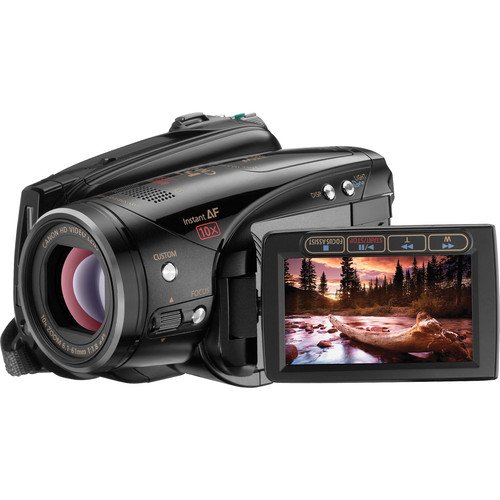
If you are searching for Canon VIXIA HV40 High Definition Camcorder review, you've got arrive at the right spot. why i declared?Because in here you will discover best review about Canon VIXIA HV40 High Definition Camcorder from real people who put it to use. There are many review relating to this product in internet but simply in here you will discover right reason to buy or otherwise. we provide you with very accurate information about Canon VIXIA HV40 High Definition Camcorder because you must know relating to this product like feature,positives and negatives. So Don't purchase this item before you read Canon VIXIA HV40 High Definition Camcorder review until finished.CHECK THIS OUT!

Product Details
- Amazon Sales Rank: #920 in Camera & Photo
- Color: Black
- Brand: Canon
- Model: 3686B001AA
- Released on: 2010-10-04
- Dimensions: 5.40" h x
3.50" w x
3.20" l,
1.20 pounds
- Display size: 2.7
Features
- HDV format delivers high-definition video to miniDV tape
- Genuine Canon 10x HD video lens; SuperRange Optical Image Stabilizer
- DIGIC DV II image processor; 24p Cinema Mode, 30p Progressive Mode
- 2.7-inch Multi-Angle Vivid Widescreen LCD
- HDMI terminal for easy, one-cable connectivity to your HDTV
- HDV format delivers high-definition video to miniDV tape
- Genuine Canon 10x HD video lens; SuperRange Optical Image Stabilizer
- DIGIC DV II image processor; 24p Cinema Mode, 30p Progressive Mode
- 2.7-inch Multi-Angle Vivid Widescreen LCD
- HDMI terminal for easy, one-cable connectivity to your HDTV
Product Description
When you take what you shoot seriously, you need aserious camcorder that lives up to your demands. TheCanon VIXIA HV40 HD camcorder does the job withastonishing high definition detail and color reproduction.The VIXIA HV40 delivers the unparalleled combination of aGenuine Canon 10x HD Video Lens, a Canon Full HD CMOSImage Sensor and DIGIC DV II Image Processor for stunningimage quality. Once you experience and see the images youcapture, you won't trust your shots to any other camcorder.Add to that the SuperRange Optical Image Stabilizer thatkeeps your video and photos steady and Instant AF, givingyou fast, accurate focus so you don't miss that importantmoment, and you've got a camcorder that's hard to match.The Canon VIXIA HV40 also offers a 2.7-inch multi-anglevivid widescreen LCD with true color, and the ability to shootin Native 24p Mode. The Canon VIXIA HV40 HD camcorderopens up a world of shooting possibilities, so check it out,you'll love what you see. Canon USA 1-year limited warrantyincluded.
Customer Reviews
Most helpful customer reviews
259 of 265 people found the following review helpful. The Latest Revision of an Excellent Camcorder
By Lon J. Seidman
Over ten years ago I bought Sony's legendary TRV-900. It was a consumer camera so good and so ahead of its time that it remained on the market for four years - an eternity in the consumer electronics industry.Canon has a similar product in their HV series HDV camcorders. They released such an outstanding camera two years ago with the HV20 that the two new models since (the HV30 and now the HV40) are really just small refinements of a mature and well designed product.**NEW FEATURES**So let's get one thing out of the way up front: There really isn't much of a difference between this camera and last year's HV30 (which was a small upgrade on the superb HV20). As an HV20 owner, I felt right at home when this arrived and I powered it up. Video quality is about the same, they look pretty much the same, and overall performance is the same too.What is different is the addition of true 24P recording which offers a more film-like frame rate over the standard 30 frames per second. It should be noted that prior versions of this camera (as well as Canon's AVCHD models) also shoot 24P but that mode requires additional software to get to "true" 24P video when editing. You'll want to check to ensure that your editing software supports true 24P footage as it's not a configuration that is on many consumer cameras.**AVCHD OR HDV?***If you're reading this it's likely that you're in the market for a new camcorder. It's also likely that you're confused over the multitude of different formats currently available: hard disk, flash memory, tape, etc. etc.Despite the many recording mediums, the current crop of consumer cameras can be delineated into two camps: AVCHD (the hard disk and flash based cameras) and HDV (tape based).HDV cameras have two advantages over their AVCHD counterparts. The first, while not as compelling a reason as a year ago, is compatibility. HDV was the first consumer HD format and is almost universally supported by just about every video editing software package released over the last three to four years. In addition the HV40 can also shoot in the older standard definition DV format, a format so old that even software and hardware from ten years ago can work with the footage.Another factor to consider is the firewire port. Want to record directly to your PC or Mac? Or perhaps do a live broadcast to UStream or Stickam? HDV cameras like the HV40 stream compressed video in realtime over Firewire, something the AVCHD cameras don't do.Still, Canon's AVCHD cameras are now recording at a higher bitrate and with a more advanced video compression algorithm that makes for better image quality. Canon's flash based cameras, like the outstanding VIXIA HFS100, are mostly solid state and lack the complex (and delicate) machinery of a tape-based camcorder like the HV40.**CONCLUSION**Canon's HV20 was a very mature product right at launch and that maturity continues in this iteration. Still, there's nothing so compelling in the HV40 that makes it a necessary upgrade for HV30 or HV20 owners. For first time buyers, if you're able to pick up an older model at a lower price you won't be making much of a sacrifice in terms of features. It's a great camera, just not any greater than the prior versions!For most consumers HDV cameras are old technology. In fact I wouldn't be surprised if the HV40 is the last tape-based camcorder Canon releases to market. AVCHD has matured to the point that I am now recommending that to friends over HDV based cameras. AVCHD's lack of moving parts combined with the very low cost of flash memory makes it tough to recommend the bulkier mechanical alternatives like the HV40.If, however, you're using an older computer or need to stream video live the HV40 is one of the best (if not the best) HDV consumer cameras on the market.
68 of 69 people found the following review helpful. Amazing Video, Easy to Use, Some Components a Bit Dated
By Scott Sherman
At the time of this writing, [...], one of the most trusted technology review sites on the web, list's the HV40's immediate predecessor, the HV30, on three its five Top Camcorders lists: Best Camcorders (Overall), Best Home Movie Camcorders and Best HD Camcorders . The only two categories in which they don't list the HV30 as one of their best models are the "Best Pro Camcorders" list (all of which are significantly more expensive than the HV30) and the "Best Budget Camcorders" list (all of which are significantly cheaper).That's a tremendous show of support for the HV30. As I write this, CNET hasn't yet published their full review of the HV40, but as it incrementally improves on some of the HV30's features, I have no reason to think CNET will think any less of the HV40's performance.As an amateur videographer, without CNET's ability to shoot with as many other models as they enjoy, I trust and value their judgement. How does the HV40 stack up against the competition? I couldn't say.As an enthusiast, however, I can share my experience and tell you that have LOVED and been amazed by the video I've gotten from this little beauty. But while the results have far surpassed my expectations, there are some limitations with the unit that made the process of shooting and transferring the footage less satisfying than the final product. Following are the pros and cons as I've seen them.Pros:Video Quality: This is far and away where the HV40 shines. I've used other consumer camcorders, and the HV40's outshines them all. Even in low light, the videos are beautiful. Colors are rich, movement is smooth and the level of detail is almost frightening. On my 24" computer screen and 52" plasma television, the images are knock-your-socks-off gorgeous. I can't imagine consumer-level video getting much better. On a few shots the camera struggled with focus, but that was rare and I can't believe any camera gets it right 100% of the time. Even on those occasions, within a few seconds the focus locked on accurately.Design: The HV40 looks and feels great in your hand. I love the piano black finish. Very classy. The camera isn't too heavy to carry around for a day, nor is it so light that it feels cheap or flimsy. I'd say Canon got this just right.Ergonomics: I found it pretty intuitive to use the HV40's controls right off the bat: The shooting and zoom controls are where I'd expect them to be. Likewise, the On-Off-Play switch and other controls were easy to find and use.Ease of Use: There's a lot to explore on this camera: Numerous shooting options, frame rates and scene modes. Some of it looks very cool and interesting, but my embarrassing confession is that I haven't used a one. I put the camera on Auto and leave it there. I just haven't had the time yet to play. Happily, even on Auto, the result are always close to perfect. I'd like someday to learn the advanced options and get more artistic with my videography; I'm just not there yet. But it's nice having a camcorder I can grow into.Built-In Video Light: I've never had one of these on a camcorder before, and I'm loving it. Comes in handy not just indoors, but for filling in harsh shadows outdoors. Sweet.Cons:Optical Stabilization: I hate criticizing Canon's Image Stabilization because I can't say if other camcorders do it better. I've had a lot of experience with Canon's still cameras and they're known for excellent stabilization. Which is why I've been so surprised how ineffective the IS is on the HV40. A lot of my video - especially from mid-zoom and higher - is too shaky to use. Of course, part of the problem is user error - like others, I often shoot using the wide-screen LCD, which is the worst way to steady your camera. Much better is to look through the eyepiece, which forces your to brace the camera against your face, rather than shakily holding it at chest level. Speaking of which...LCD and Viewfinder: I'm surprised how unimpressive the HV40's LCD and viewfinder are. I have the Canon HV20, which is two-generation old technology, and I don't think they've upgraded either of these important components since then. At 2.7 inches, the wide screen LCD feels cramped. For comparison, an iPod Touch or iPhone's screen is a roomy 3.5 inches. Moreover, the resolution on the HV40's LCD is a trifling 211,000-pixels; again, not upgraded from a model over two years old. That means your LCD doesn't show a lot of the detail you're capturing with the camera. Even worse is the eye-level viewfinder, which is so coarse and grainy as to be barely acceptable. Since that's the viewfinder you should be using when you shoot, it really needs to be improved. The only good news is that after viewing your video through the eyepiece or using the LCD, you'll be astounded at how much better it appears when you eventually display it on a computer or TV.Tape-Based Technology: There have been many debates on hard-drive vs. taped-based camcorders. To my understanding, tape-based video continues to hold an edge when it comes to quality and compatibility with computer-editing programs. I don't care: I'm ready to leave videotapes behind. Using the miniDV tapes feels very 1980's to me. They're slow to rewind and fast forward, you can't jump to a specific scene and when transferring them to a computer, it happens in real time - i.e., 30 minutes of shooting takes 30 minutes to download to your PC. I prefer MP3 players to cassette tapes, my DVR to a VCR, and DVDs to videotapes. This miniDV shooter is the last thing I have to use tapes with, and I'm ready for what's next.Conclusions: The Canon's HV40's pros are far more important than its cons, with the first one, video quality, really being the primary concern. With the HV40's outstanding output, its impossible not to love what comes out of this camera. The camera also feels great and is easy to use. Still, I'm deducting a star for the cons, which, while not of primary importance, remain disappointments. Most notably, its past time to upgrade the LCD and viewfinder and to make the switch to hard drive based storage (not everyone agrees on that last point, though; miniDV does have its adherents).As a point of interest to Mac users - I transferred and edited the video from the HV40 to my two-year-old iMac with no problems. I've upgraded to the iLife 09 package, and iMovie 09 had no problems importing or displaying the video. Although iMovie recommends you import your video at a reduced size (which saves hard disc space and is less processor intensive to work with) I imported everything at full resolution and had no problems, crashes or slowdowns while working with it. Not only that, but, (without going off on too much of a tangent) it was a great pleasure using iMovie 09 with the HV40's video - moving footage around and making edits was painless and, using one of Apple's template, my movies look like professionally edited mini-masterpieces, which is less a tribute to my limited-skills as it is testimony of their slickness and usability of that program. Bottom line: If you're on a modern Mac, the HV40 works with it flawlessly.Scott Sherman, author, Lambda Literary Award Winning Best Men's Mystery, 2009, First You Fall: A Kevin Connor Mystery
94 of 98 people found the following review helpful.The HV40 Continues Canon's Dominance of the Consumer HDV Market
By Harley Head
The Canon HV40 is basically a slightly improved Canon HV30 (which itself was a slightly improved HV20), with a few extra features. The HV line has been very popular the past few years and has a devoted following of fans and enthusiasts. There are even web sites devoted to the HV line. So if you wish to research the HV line in-depth, the resources are definitely there. Moving on to the HV40 in specific, the biggest new feature is 24P recording which offers footage more comparable to real film. To be honest, I doubt this feature will matter or make a difference to the average consumer, but for film students, enthusiasts, and professional videographers, it offers more creative control and that true "cinema" effect. There are plenty of sample videos posted on the web demonstrating the effect of 24P (and the HV40 itself). The HV40 maintains the Canon HV line reputation of being the cream of the crop among consumer HDV cameras. However, with AVCHD significantly closing the gap, both in image quality and compatibility, with HDV this past year, the HDV format is disappearing rapidly from the consumer market. The excellent image quality of the latest ACVHD cameras now surpasses HDV. Coupled with the speed and convenience of tape less recording, this makes AVCHD an almost irresistible choice if you are currently shopping for a video camera. Although I agree AVCHD is the more future-proof choice, there are several compelling arguments to consider the HV40. First, and most importantly, is its backward compatibility with HDV or SD mini-DV. If you have a library of mini-DV tapes, you can play them and capture to PC with this camera. Your existing video editing software (if any) is also more likely to be compatible with the HDV format, even if it's a few years old. Also, as I mentioned earlier, although ACVHD has made great progress, it's still not the most system friendly format. This can be a major hurdle if you have an underpowered or older PC. On a single core or budget CPU system, AVCHD may likely give you significant headaches. In fact, if your system is really old or underpowered enough, you may have to add a system or video card upgrade into the budget if you wish to use AVCHD files beyond basic capture. If you're simply looking for a high-definition video camera that you can use with your existing software and system, yet still capture amazing footage, the HV40 is a good choice, especially if you already use mini-DV. Another consideration is storage. HDV is self-contained. You can capture, edit, burn a DVD, and delete the footage from your system to preserve disk space, yet still have a backup of your footage on a cassette. With AVCHD, you have to allocate permanent storage space on a hard drive or burn your captured files to optical disk as backup, the latter being very inefficient with current 4.7GB DVD's. Of course, the downside with HDV is that you have to purchase tapes, but they are pretty cheap these days, especially for multi-packs. You can use regular mini-DV tapes. There is no requirement or need to purchase more expensive HDV specific tapes. This is strictly a personal choice. Frankly, I've tried both and see no difference between the two. And although AVCHD does not require tapes, you do have to buy SDHC cards for card-only models and/or an additional hard drive (internal or external) to efficiently back up your footage, especially with hard drive or solid state drive models. So the costs even out in the long run. Although the Canon HV line may no longer be king of the consumer video hill, the HV40 can easily hold its own in video quality against all but the very best consumer AVCHD cameras. Even then, the difference is slight at best. I have captured footage from both formats under similar shooting conditions on both PC and Mac. The HV40 performed admirably against AVCHD. In a lot of instances, the HDV footage was even noticeably better than AVCHD. Not all AVCHD cameras are created equal. You may or may not get a decent AVCHD camera, depending on your research. In some cases, you may actually take a step backwards in quality. All the sophisticated electronics in the world can't correct bad optics, sensors, and poor auto-focus performance. The HV40 slams the ball out of the ballpark on all three features, thanks to Canon optics & sensor, and swift reliable auto-focus. This brings me to my final point of comparison, watching and sharing video. After the footage is shot, if all you wish to do is connect the camera directly to your high-def television and play the footage through the camera, AVCHD might (and I can't emphasize the word "might" enough) be the hands-down winner. However, most people want to burn their memories to DVD. In this case, unless you have a drive capable of burning high-definition blu-ray disks and a compatible stand-alone blu-ray player to play them on, your footage will be encoded into a standard definition DVD anyhow. Footage from the HV40 will perform this type encoding quicker and more efficiently. Honestly, until high-definition blu-ray burners become more affordable, much of the high definition performance for either format is wasted unless you encode video files in high-definition for viewing on computer or, as I said earlier, plan to simply playback footage through the camera. The form factor and dimensions of the HV40 are identical to the HV30. One complaint that I, and many others, had with the HV30 was the awkward feeling in your hand. For some reason the HV40 did not feel quite as awkward. They appear identical, so I think I just got accustomed to the feel of the HV30. The only visible difference (besides the new name), is the change in name of the button on the lens barrel, from "BLC" to "Custom". The newly named button offers additional exposure and focus assist options in addition to the back light compensation of the former "BLC" button. Otherwise, the HV40 is virtually identical to the HV30.Performance is great, as expected. Video is very clear, with crisp colors and razor sharpness. Performance definitely on par with its predecessors, the HV20 and HV30.I have not personally tried the 24P mode, however, as I mentioned earlier, there are several examples of this feature readily available on the web. Bright light recordings were sharp, vivid, and clear. Low light capability was pretty good with minimal noise unless the light was really dim. I've achieved okay footage by candle light, although it definitely starts to show limitations under such extreme dim light conditions. Auto focusing was fast and spot-on, especially the instant AF which quickly switches focusing from one object to another as you switch perspectives or angles. There is a choice to use manual focus which sometimes comes in handy with difficult focusing situations such as zooming in on objects at a certain distance or objects without enough contrast for the auto focus. Once again, there is plenty of test footage of the HV line readily available on the web. Sound was good, especially for a tape camera. There was no noticeable noise from the tape transfer mechanism unless you were recording in near silent conditions. Even then, it was minimal. The HV40 also has 3.1MP still picture capabilities with a few customizable features such as different metering and exposure options. Still pictures are adequate quality and comparable to low-end digicams. You will need to purchase a mini-SD card to capture pictures. Battery life was average.The bundled software is a joke. It is literally useless for video. They bundle the same still-photo application (Zoombrowser EX for PC/Imagebrowser 6.2 for Mac) that is included with their digital still cameras but nothing for capturing or editing video. Fortunately, the HV40 is compatible with most editing software from the past few years. As for built-in video software, only the Vista Home Premium and Ultimate versions of Windows Movie Maker will capture and edit HDV. However, one caveat is that it is converted into a proprietary Microsoft format after capture. If you want a cross-platform friendly file, use a third-party app. On the Mac side, users should have no problems with any version of iMovie. (Thanks yet again Apple, for keeping things simple. And this is from a PC-biased guy!) Export options include firewire and USB 2. I prefer and use firewire on both Mac and PC. There are also component and HDMI outputs for connecting to a high definition TV. Thankfully, the HDMI connector is standard size, so you can use an existing HDMI cable if you have one, rather than buying the specialized one most cameras require. As usual, component cables are included but no HDMI cable. They also include a remote.All in all, the HV40 improves on a time tested and proven model. Going back to the HV20, the HV line has consistently offered top quality, features, and performance. The HV40 is the latest in that outstanding line and offers a very compelling option for some not to jump on the AVCHD bandwagon just yet.

CERTAIN CONTENT THAT APPEARS ON THIS SITE COMES FROM AMAZON SERVICES LLC. THIS CONTENT IS PROVIDED "AS IS" AND IS SUBJECT TO CHANGE OR REMOVAL AT ANY TIME.
The Canon VIXIA HV40 is one of the latest additions to our ... The VIXIA HV40 is the premium quality High Definition video tape camcorder for sophisticated and ...
Amazon.com: Canon VIXIA HV40 High Definition Camcorder: Camera & Photo
The Canon VIXIA HV40 is one of the latest additions to our large family of HD camcorders. For those seeking the ultimate in HD video quality, we bring a host of Canon ...
Canon VIXIA HV40 High Definition Camcorder 3686B001 B&H Photo
Buy Canon VIXIA HV40 High Definition Camcorder features HDV / DV Recording, miniDV Cassette. Review Canon Camcorders, Camcorders
Canon U.S.A. : Consumer & Home Office : Consumer Camcorders
VIXIA HV40 Compare: $599.99: ... All camcorder accessories discounted when registering your camcorder >> Discover the advantage of Canon High Definition Video >> Careers
Canon Direct Store- VIXIA HV40 HDV
Canon Direct Store - High Definition Camcorder ... The Canon VIXIA HV40 is one of the latest additions to our large family of HD camcorders.
Amazon.com: Customer Reviews: Canon VIXIA HV40 High Definition ...
5 stars. "The Latest Revision of an Excellent Camcorder" Over ten years ago I bought Sony's legendary TRV-900. It was a consumer camera so good and so ahead of its ...
Canon VIXIA HV40 Black High Definition HDV Mini DV Tape Camcorder ...
Shop Low Prices on: Canon VIXIA HV40 Black High Definition HDV Mini DV Tape Camcorder : Camcorders
Question about Canon VIXIA HV40 High Definition Camcorder? - Yahoo ...
Best Answer: The Canon HV40 captures standard definition DV and high definition HDV format video to miniDV tape. DV and HDV are the formats used by most ...
Canon LEGRIA HV40 High Definition DV Camcorder - Camcorders ...
Canon VIXIA HV40 High Definition Camcorder. When you take what you shoot seriously, you need aserious camcorder that lives up to your demands. TheCanon VIXIA HV40 HD ...
Used Canon VIXIA HV40 High Definition Camcorder 3686B003AA B&H
Buy Canon VIXIA HV40 High Definition Camcorder features HDV / DV Recording, miniDV Cassette. Review Canon products.

Rating: 100% based on 99998 ratings. 5 user reviews.
Ditulis Oleh 9:27 PM
0 comments:
Post a Comment